What Kind of Person Actually Succeeds as a Hammer & Nails Franchise Owner?
Article Summary
Not net worth, credit score, or free time, the usual eligibility checklist. Three dispositions matter more: seeing the business as an experience rather than a commodity service, building a culture where the work isn't about the owner, and staying open to owning more than one location over time. None of the three appears on a franchise application.
Capital only tells you someone can start, not whether they'll make the daily judgment calls that keep members coming back. And requiring full-time availability filters out accomplished professionals whose time is already spoken for while filtering in people with the least other opportunity, the opposite of a useful screen.
It's the shift from thinking the haircut or pedicure carries the value to understanding the experience does: the chair angled toward the guest, the artist who remembers details, the routine that turns a transaction into a standing appointment. Owners who miss this compete on price and speed and never understand why members pay a premium.
Because members need the same recognition on a Tuesday when the owner isn't in the building. That requires a leader who builds and defends values through other people rather than personally doing every job, a leadership discipline that scales beyond one location, which is exactly what owning multiple shops requires.
One well-run shop is a genuinely good outcome for many owners. But owners open to a second or third location improve their odds: a single underperforming site carries more weight alone than it does spread across a portfolio, and multi-unit operators already control roughly 58.8 percent of all franchised units nationally.
The honest answer has almost nothing to do with a résumé or a credit score. It comes down to three ways of seeing the business, and the people who have them tend to do well whether they run one shop or five.
Ask most franchise systems who succeeds as an owner and you will get an answer built around a checklist: net worth above a threshold, liquid capital on hand, a clean credit history, and enough free time to stand behind the counter. Those things are not irrelevant, a business still has to be funded and staffed, but they describe who is eligible, not who does well. They are the screen at the door, and the trouble with that screen is that it lets through plenty of people who never should have signed, and turns away plenty who would have thrived. An earlier article in this series described the blunt reality that in the standard franchise-development process roughly twenty-four out of twenty-five leads are set aside. What that number hides is the quieter problem on the other side: among the ones who are waved through, the checklist was never a very good predictor of who would build something that lasts.
At SummitView, we think about the question differently. A few members of our management team come from the capital-markets side rather than from inside franchising, and as one of the largest ownership groups in the Hammer & Nails system, we have watched what actually predicts success play out across our own shops. In our experience, the attributes that most reliably lead to success have little to do with a financial profile. Three dispositions matter far more. A person who understands they are buying an experience business, not a barbershop. A person committed to building a culture in which the work is never about them. And a person who thinks bigger about scale: open to owning more than one location over time. None of the three appears on a franchise application, yet all three, we believe, are what separate the owners who succeed from the ones who merely qualified.
Why the Usual Screen Measures the Wrong Thing
It is worth being clear about why capital and availability are such weak predictors. Capital tells you a person can start; it says nothing about whether they will make the hundred small judgment calls that determine whether a shop becomes a place people return to. Availability, the free weeknights the traditional owner-operator model demands, is arguably worse than neutral, because it quietly filters for the people with the least other opportunity and against the accomplished professional whose time is already spoken for. The good doctor who should stay a doctor, the executive with real commercial instincts but no open evenings: the conventional model moves them politely to the side, not because they would make poor owners but because they cannot make full-time operators.
When franchisors themselves are asked what actually drives franchisee success, the answers are strikingly consistent and strikingly un-financial. In a Franchise Business Review survey of what characteristics separate top performers, the traits named again and again were coachability and a willingness to follow the system, natural people skills and comfort with relationship-building, grit through the inevitable hard stretch, and, tellingly, a focus on hiring, training, developing and retaining staff. One operator quoted in that survey put its top owners’ edge down to being “process-driven,” organized around “structure, cadence, and operational excellence.” Not one of those is a number on a balance sheet. They are dispositions, and dispositions, in our view, are what actually drive success. The three attributes below are a sharper, category-specific version of the same insight: the owner who wins at Hammer & Nails is defined by how they think, not by what they have.
Trait One: They See an Experience Business, Not a Barbershop
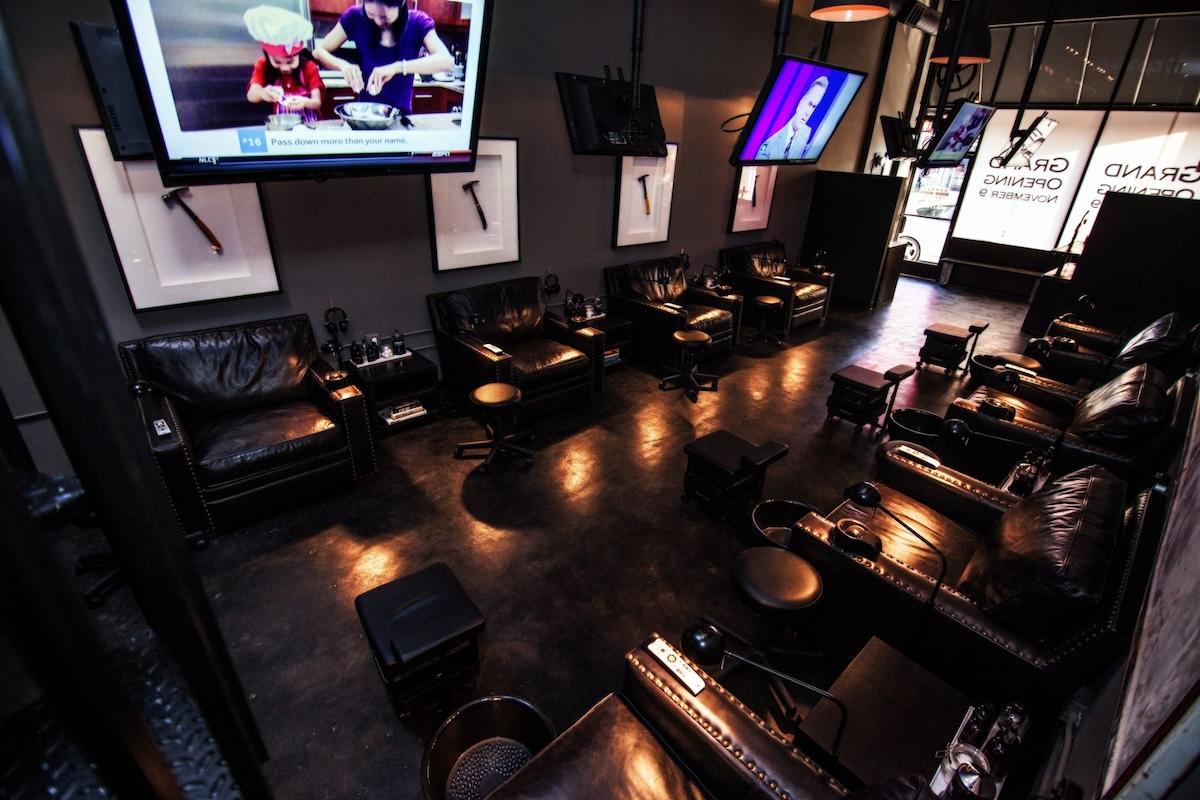
The first is a particular light-bulb moment: the point at which a prospective owner stops thinking of the shop as a place that sells haircuts and pedicures and starts thinking of it as a place that sells an experience. The distinction is not cosmetic. It is not the haircut or the pedicure that carries the value; it is the experience. The person who never quite makes that shift will run the business like a commodity service, competing on price and speed, and will be perpetually confused about why members pay a premium and keep coming back. The person who gets it will protect the thing that actually generates the value: the chair angled out toward the guest, the artist who knows the clipper size and the beard color and asks about the guest’s family, the member’s favorite cocktail poured and waiting the moment he arrives, the routine that turns a transaction into a standing appointment.
This is not a piece of brand mysticism; it is one of the better-documented ideas in modern business. Nearly three decades ago, in the Harvard Business Review, B. Joseph Pine II and James H. Gilmore argued that economic value had climbed a ladder, from commodities to goods to services and, finally, to experiences, and that as goods and services grow commoditized, the businesses that deliberately stage a memorable, personal experience are the ones that command a premium and earn genuine loyalty. Their now-famous illustration is the birthday cake: the raw ingredients cost pennies, a boxed mix a dollar or two, a bakery cake ten or fifteen, but the staged birthday experience at a venue built for it commands a hundred dollars or more. Hammer & Nails sits squarely in that top rung. The owner who instinctively understands the experience economy is not learning a sales script; they are seeing the business as it actually creates value. The one who does not will keep trying to sell the cake by the pound.
Trait Two: They Build a Culture Where It Isn’t About Them
The second attribute is the one we believe matters most, and it is a form of leadership rather than a skill. The owners who succeed are committed to building a culture, and the animating rule of that culture is that the work is never about the owner or even about the artist. The discipline is simple to state and hard to live: it is not about me; it is about the member and the guest. The artists in the shop should be blessed with real financial outcomes, able to build careers and raise families on the work, but the price of that is accepting a responsibility that points outward. Inside the shops, the saying is plain: we don’t make our problems theirs; we don’t talk about us, we talk about them. An owner who cannot lead that way, who needs the business to be about their own ego or comfort, will erode the exact thing that makes members stay.
This is where the leadership trait meets the operational one, because a culture like that is built through people, and the franchisors surveyed by Franchise Business Review kept returning to the same point: the owners who last are the ones who take hiring, training, developing and keeping their staff seriously, and who lead by structure and example rather than by title. This calls for a leader who every day says the hard thing and speaks plainly, who sets the standard out loud and holds it. It is worth naming what this trait is not. It is not charisma, and it is not the ability to do every job on the floor personally. It is the willingness to build and defend a set of values through other people, so that a guest gets the same recognition on a Tuesday when the owner is nowhere in the building. That is a leadership disposition, and it travels well beyond a single location, which is exactly what the third trait requires.
Trait Three: They Think Bigger About Scale
The third attribute is a way of thinking about scale, and it deserves a careful statement. Owning a single Hammer & Nails location is a genuinely good path. Many owners build an excellent business and a rich professional life around one well-run shop, and for plenty of people (for reasons of focus, capital, or simple preference) one location is exactly the right choice. Nothing about this trait argues otherwise. What it describes is something subtler: the owners who tend to do best are the ones who stay open to thinking bigger, who see their first shop not necessarily as their last, and who are willing to consider a second or third location as the opportunity and their own capacity allow.
The reason thinking bigger can improve the odds is straightforward, and it is about probability rather than ambition for its own sake. Even a strong operator can occasionally land a site that underperforms: trade areas shift, a lease disappoints, a corner that looked perfect turns out ordinary. With a single location, that outcome carries more weight; across two or three, a soft site becomes a manageable event that the others help carry, and the owner also gains real leverage with landlords, vendors and staff that is hard to negotiate for one shop alone. This is where experienced franchise ownership has been heading for years: multi-unit operators now control roughly 58.8 percent of all franchised units in the United States as of 2025, a share that has climbed steadily, according to FRANdata's 2026 Economic Outlook report, precisely because scale is one of the ways seasoned owners improve their probability of success. The important nuance is that “thinking in multiples” is a disposition, not a purchase order. It is simply the willingness to see growth as an option worth weighing rather than one ruled out from the start.
The Profile at a Glance
Set side by side, the three traits describe a way of seeing rather than a set of credentials, and each has a mirror-image failure mode worth recognizing in oneself.
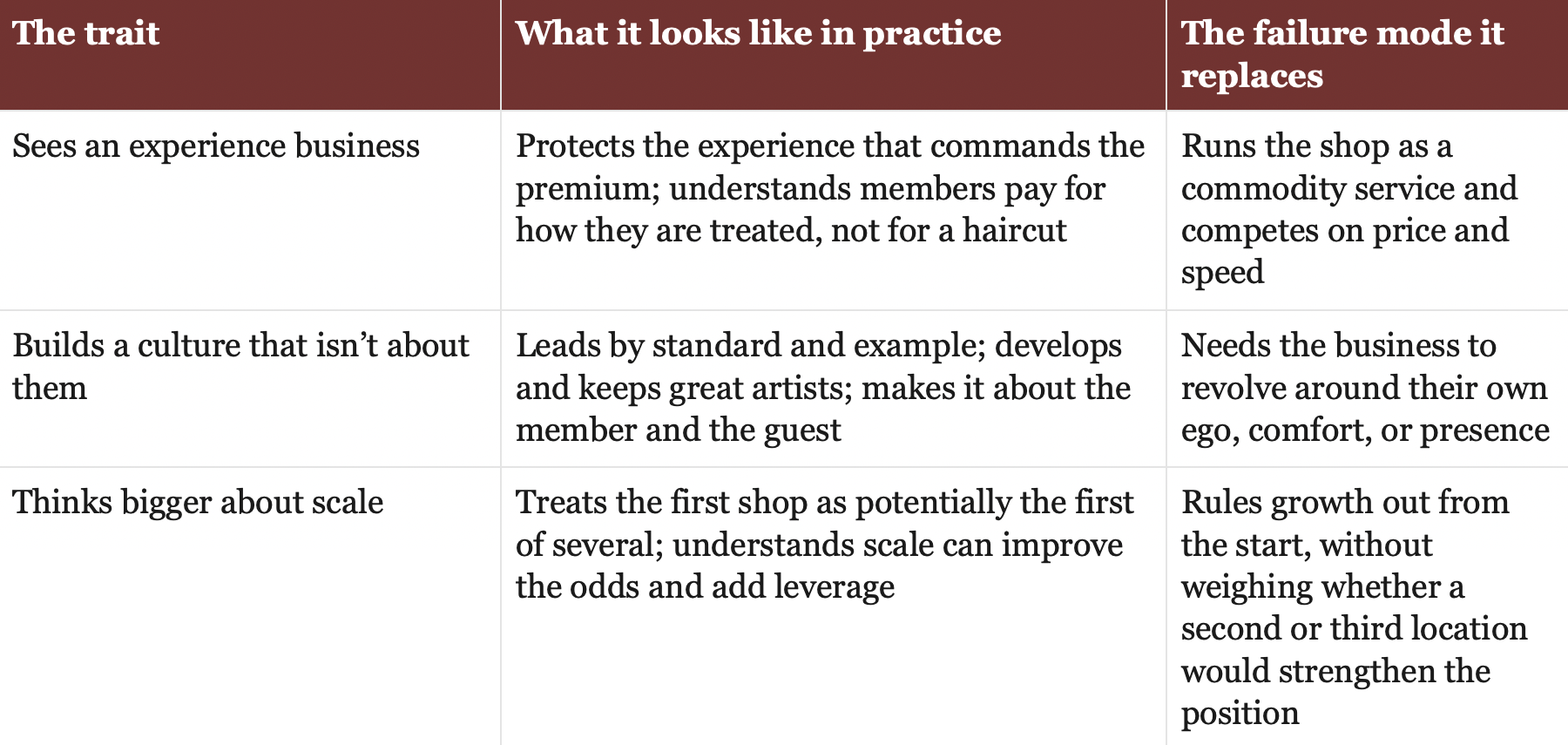
Read down the middle column, none of it is about how much money the person walks in with. Read down the right, none of the failure modes is cured by capital. That is the whole point: the checklist at the door measures resources, and these three traits measure judgment. A person can clear every financial hurdle and still carry all three failure modes; another can have every one of the three dispositions and simply need the right structure to put them to work.
Why the Structure Follows the Person, Not the Other Way Around
There is a reason this matters at SummitView specifically. Because the platform offers more than one way in (an equity stake in the fund, a shop you own and operate yourself, or the hybrid path where you own a location without running it day to day), the three traits are not a gate that decides whether you belong. They are a lens that helps identify which door fits. The person with a powerful multi-unit mentality and a demanding career may express these traits best as an owner of several hybrid locations, thinking like a portfolio holder while a professional operator runs each shop. The person who wants their hands on the culture directly may be a natural solo owner-operator. The traits are constant; what changes is the vehicle. This is the inversion of the usual model, where the structure is fixed (you operate, full stop) and the person is forced to fit it or be turned away.
It is also why we regard the twenty-four out of twenty-five not as a filter but as a waste. Many of those people carry the three dispositions in full; what they lacked was never the temperament to own well, only the free weeknights to operate. Give the right person a structure that fits how they think, and the trait that mattered, the way of seeing the business, is finally allowed to do its work.
The Real Question
The question that titles this article has a tidier answer than most people expect, and it is not the one the application form is asking. The people who succeed as Hammer & Nails owners are the ones who see an experience where others see a service, who build a culture that points at the member instead of at themselves, and who stay open to thinking bigger about scale over time. Those are dispositions, not credentials, which is both the good news and the honest challenge in it. You cannot buy your way to them, but you also do not need anyone’s permission to have them. If you recognize yourself in all three, the next question is only which of the three doors fits the way you already think. That is worth a conversation.
To learn more, visit summitviewtexas.com.
This article is for informational purposes only and does not constitute an offer to sell or a solicitation of an offer to buy any security or franchise. Franchise, co-ownership, shared-services, and fund arrangements are offered only through definitive agreements and applicable disclosure documents. Ownership structures, store counts, and development plans reflect the platform’s current intentions and are subject to change. Descriptions of owner traits reflect management’s experience and views and are not a guarantee of results; individual outcomes vary.
•••••
Sources
- B. Joseph Pine II & James H. Gilmore — “Welcome to the Experience Economy,” Harvard Business Review (the ladder from commodities to goods to services to experiences, and the premium commanded by businesses that stage a memorable, personal experience). https://hbr.org/1998/07/welcome-to-the-experience-economy (freely available summary: https://uen.pressbooks.pub/servicesmgt/chapter/chapter-17-the-experience-economy/)
- Franchise Business Review — “Which Traits & Characteristics Contribute to Franchisee Success in Your Franchise System?” (franchisors identify coachability, people skills, grit, and staff development — not financial profile — as the drivers of franchisee success). https://franchisebusinessreview.com/post/which-characteristics-contribute-to-franchisee-success/
- FRANdata — “Multi-Unit Growth by the Numbers” (multi-unit operators control roughly 58.8% of U.S. franchised units, a share that has continued to rise, as experienced owners use scale to reduce risk). https://frandata.com/multi-unit-growth-by-the-numbers/
Third-party market data and research above are presented as reported and have not been independently verified. Statements describing the SummitView and H&N Texas platform — its three-company structure, its three routes to ownership, its current Texas footprint, and its development plans — are drawn from the company’s investor and platform materials, including the H&N Texas Holdings, LP investor presentation. Statements of the platform’s investment philosophy and owner criteria reflect management’s experience and views. Any observations not attributable to an outside source reflect management’s experience, views, and beliefs, and are not independent research or a guarantee of results.
Comprehensive Summary
What actually predicts success as a Hammer & Nails franchise owner?
- The usual checklist measures the wrong thing: net worth, liquid capital, credit history, and free time describe who is eligible, not who performs well once they're in the chair.
- Franchise Business Review's own survey backs this up: when franchisors are asked what actually separates top performers, the answers are coachability, people skills, grit, and a focus on developing staff, not a financial profile.
- Three dispositions matter far more here specifically: seeing the business as an experience rather than a commodity, building a culture that points outward rather than at the owner, and staying open to owning more than one location over time.
- None of these three shows up on a franchise application, which is exactly the gap this piece exists to close: the traits that predict success and the traits that get screened for aren't the same thing.
Why don't capital and availability predict who succeeds?
- Capital only proves someone can start: it says nothing about whether they'll make the hundred small judgment calls that determine whether a shop becomes somewhere people return to.
- Availability is arguably worse than neutral: requiring full weeknights filters for people with the least other opportunity, while filtering out the accomplished professional whose time is already committed elsewhere.
- The result is a screen that fails in both directions: it lets through people who were never going to build something lasting, while turning away people who would have thrived under a different structure.
- The fix isn't a better checklist, it's a different question entirely: whether someone has the disposition to succeed, not whether they clear a financial bar.
What does "seeing an experience business, not a barbershop" actually mean?
- The distinction is where the value actually lives: not in the haircut or the pedicure itself, but in the staged, personal experience around it, a well-documented idea in modern business going back to Harvard Business Review's "experience economy" framework.
- Owners who miss this compete on the wrong axis: price and speed, the commodity-service playbook, rather than the premium and loyalty a staged experience commands.
- The details are the product, not decoration: the chair angled toward the guest, the artist who remembers preferences, the routine that turns a transaction into a standing appointment.
- Getting this right is what makes membership sellable at all: it's introduced during a service the member already values, not pitched cold at the counter.
Why does building a culture "not about the owner" matter so much?
- This is a leadership disposition, not a skill: the willingness to build and defend a set of values through other people, rather than personally handling every interaction.
- The test is consistency without the owner present: a guest should get the same recognition on a Tuesday when the owner is nowhere in the building.
- Franchise Business Review's data points the same direction: the owners who last are the ones who take hiring, training, and staff development seriously, and lead by structure rather than by title.
- This trait is what makes multi-location ownership possible at all: a leadership approach that depends on the owner's personal presence can't extend past one shop, but one built through people and systems travels naturally.
Is thinking bigger about scale required to succeed, or is one shop enough?
- One location is a legitimate, often excellent outcome: many owners build a full business and career around a single well-run shop, and nothing about this trait argues otherwise.
- The advantage of thinking bigger is about probability, not ambition: a single underperforming site carries its full weight alone, while the same soft site across a two- or three-unit portfolio becomes a manageable event the others help absorb.
- Scale also buys leverage that's hard to get with one shop: better terms with landlords, vendors, and staff come more easily to an owner who can offer more than one location's worth of business.
- The trend already reflects this: multi-unit operators now control roughly 58.8 percent of all franchised units nationally as of 2025, a share that has climbed steadily as experienced owners lean into scale to reduce risk.
What are the actual ways to participate in the SummitView platform?
- The platform offers three distinct doors, not one fixed structure: an equity stake in the fund, a shop owned and operated directly, or a hybrid path that owns a location without running it day to day.
- The three traits function as a lens, not a gate: they help identify which door fits a given person's temperament and career demands, rather than deciding who belongs at all.
- This inverts the traditional franchise model: most systems fix the structure (you operate, full stop) and force the person to fit it or be turned away; here the person's disposition determines the structure instead.
- That inversion is the real point of the piece: many of the prospects screened out by a standard checklist actually carry all three dispositions in full, what they lacked was never the temperament to own well, only a structure that matched how they think.