
The Case for Men's Grooming: Why We Chose Hammer & Nails as Our Flagship Franchise Brand
Article Summary
Because the underlying behavior is a generational shift rather than a passing trend. Men caring about their appearance isn't new, the last time it expressed itself this fully ran for roughly half a century between 1870 and 1920, and today's version is anchored to conditions that don't reverse: appearance carries professional weight it didn't two generations ago, and the stigma that once kept men out of a grooming chair is gone.
The money is following. In a December 2025 survey, 68% of Gen Z and millennial men said they care more about their appearance than five years ago and 51% said they're spending more on it. Men now outspend women on monthly grooming, and skin care use among men aged 18 to 27 rose from 42% to 68% in just two years. The growth isn't in haircuts, it's in services men didn't used to buy at all: hands, feet, skin, and beard work.
Because it changes what building a platform actually costs. IBISWorld describes barbershops as so fragmented that no single company holds even 5% of the market. In a category with an established incumbent, a later entrant has to buy site access, brand recognition, and purchasing leverage. In a category with no incumbent, scale itself becomes the advantage, and being early to build it matters.
Members pay monthly dues for a set number of services, no contract, no cancellation penalty, and credits roll over. That means the business starts each month with committed revenue rather than at zero, which is a structurally different asset than a pay-per-visit shop with identical EBITDA, and buyers price that difference. It's also evidence the underlying behavior is real: people don't commit to monthly dues on a whim.
Labor, not demand. The constraint is finding and keeping licensed barbers and technicians who are good at the work and good with people, and every operator draws from the same limited pool. The approach here is to treat the job as a profession, competitive pay, real training, and a career structure, since in a service business, whoever wins the competition for talent wins the category.
Twenty years ago, a man who got a pedicure did not mention it. Today he books it on his phone between meetings. It is a small thing on its own, but it points to a larger change, and that change is where this platform began.
SummitView is the franchise investment platform behind H&N Texas Holdings, LP, which develops, owns and operates men's grooming locations across Texas. Choosing the category and the brand was our first decision and our most important one, because everything after it is execution. A great operator in a fading category is working much harder for much less.
So we asked several questions before committing a dollar. Is this a lasting shift or a passing one? Is spending genuinely moving into the category? Is anyone national already there? Is the customer young enough, and broad enough, to be worth decades of visits? And does the geography actually drive franchise economics? The first question governs the rest, because if we get that one wrong the others do not matter. Hammer & Nails Grooming for Guys, the national men's grooming franchisor, answered every one.
A Generational Trend, Not a Fad
We build against trends and stay away from fads, for a simple reason: the commitments here are long. Leases run a decade and buildouts cost real money. If the behavior underneath the concept fades in three years, even a well-run shop is left competing for a customer who has moved on.
The difference between them is how long they last, and that comes down to what sits underneath. A fad runs on novelty: it burns brightly for a season or two, stays with the group that discovered it, and leaves behavior where it found it. A trend is powered by something structural (a change in how people live, work, or see themselves), and because that cause does not reverse, neither does the behavior. Trends run for years and usually decades, they broaden rather than narrow, and they show up in several categories at once.
Men caring about their appearance, and wanting places of their own to see to it, is not a modern invention, and the last time it expressed itself fully, it ran for roughly half a century. Between 1870 and 1920, American men wore beards and tailored clothes, joined lodges and social clubs by the millions, and treated the barbershop as somewhere to be among other men rather than somewhere to get a haircut. A study of period portraits found facial hair peaked in the 1880s, when roughly nine in ten men wore some (Robinson, 1976); historians call those same decades the Golden Age of Fraternalism (Chamberlain, 2022). Styles moved on afterward, as styles do. The impulse underneath them did not.
What separates today from a passing style cycle is that the behavior is anchored to conditions that do not reverse. Appearance carries professional weight it did not two generations ago. Men work longer and stay visible later in life. And the stigma that once kept a man out of a grooming chair is gone: no one under fifty finds any of this remarkable, and that is not a door that swings closed again.
That is the kind of change worth building against. The next question was whether the money was following it.
A Structural Shift in How Men Spend
People are stable in how they divide their discretionary income until something changes them. Over the past decade, men, younger men especially, have moved money toward experience and appearance. A change in what people buy outlasts a change in how much.
The clearest numbers are about men themselves. In a December 2025 survey of American Gen Z and millennial men, 68% said they care more about their appearance than five years ago and 51% said they are spending more on it (Talker Research for Just For Men). Skin care use among U.S. men aged 18 to 27 reached 68% in 2024, up from 42% two years earlier (Mintel). And men now outspend women on monthly grooming, $90 against $80 (Bread Financial and Ulta Beauty).
Here is the part that surprises people: haircuts are not the growth. Men have always bought haircuts, and a better one is an improvement rather than an expansion. The growth is in what men did not used to buy: hands, feet, skin, beard work. Men now account for roughly three in ten nail salon customers, and theirs is the fastest-growing segment of that market, projected to expand at 8.7% a year through 2030 against 7.9% overall (Grand View Research), a North American market of about $17.4 billion in 2026 that names male grooming as a principal driver (Global Market Insights). What was unmentionable twenty years ago is now unremarkable, and the numbers have caught up. It is the biggest reason we did not simply buy into a barbershop chain.
The industry data agrees. IBISWorld puts U.S. barber shop revenue near $7.0 billion in 2026, growing roughly 9.8% a year through 2025, with the wider hair, nail and skin care services industry at about $95.3 billion. The Bureau of Labor Statistics expects retail trade to shed jobs through 2034 while barbers, hairstylists and cosmetologists grow 5%. Money is moving out of things and into services. We wanted to own the service.
The Experience Is Part of the Product
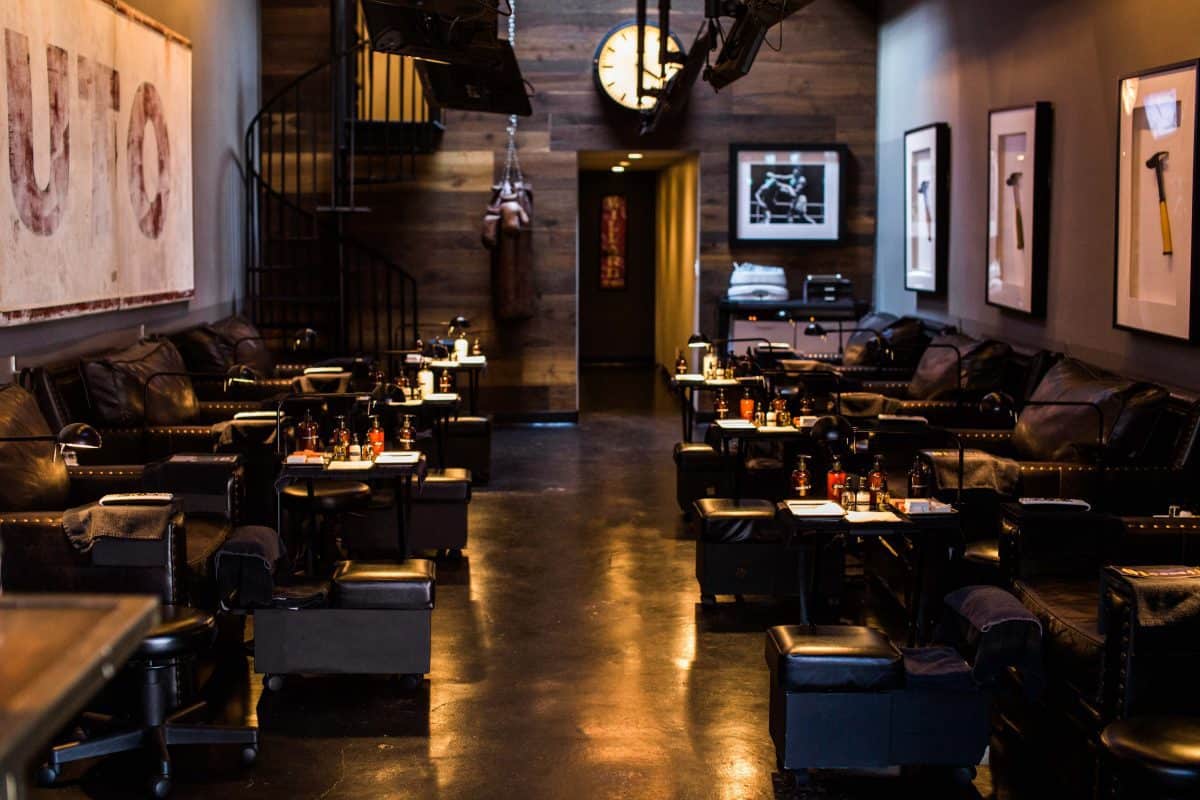
A skilled cut matters, and a man can tell the difference immediately, which is why we invest heavily in the people holding the shears. But craft alone does not explain why a man comes back every two weeks or pays a premium to do it. The room does part of that work, and the relationship does the rest. Walk into one of our shops and the first thing you see is a bar, not a reception desk. That is deliberate: it tells a man within seconds that he has not walked into a barbershop.
The rest follows the same logic. Chairs face outward instead of into a mirror, so the conversation happens face to face, a small change anyone who has been talked at through a reflection will appreciate. Services run thirty to sixty minutes, several times the turn time of a quick-cut chain. What a member likes is written down and travels with him, so the same haircut waits for him in another city. None of this is decoration. It is what turns a good service into a place a man belongs to, and it is how membership gets sold: introduced during the service, not pitched at the counter on the way out.
No National Competitor in the Category
The next question eliminates most otherwise attractive concepts, and it is where men's grooming is genuinely unusual. There is no dominant national men's grooming brand. IBISWorld describes barber shops as so fragmented that no company holds even 5% of the market. Excellent local operators exist in every city; a national name exists nowhere. Nor is there a chain of hand-and-foot care destinations built for men, a gap any man who has sat uncomfortably in his wife's nail salon can confirm without being shown data.
The precedent is massage. Twenty-five years ago a national massage chain sounded implausible, until an operator saw that the definition of wellness had widened and built for it. Being first guarantees nothing. Plenty of first movers get overtaken. But in a category with no incumbent, scale buys brand recognition, site access and purchasing leverage a later entrant has to pay for rather than build. Hammer & Nails is in that position now, and because it is full-service (cuts, shaves, beard and color work, facials, and a dedicated hand-and-foot room), a barbershop is less a competitor than a narrower alternative.
The Customer Is Young, and He Is Not Narrow
A man who starts a grooming routine in his thirties is not a one-time sale. He is a relationship that can run for decades, and routines like this one tend to hold once they become habit. That is why the age profile of the brand and of the market belongs in our underwriting and not only in our marketing: the earlier a man joins us, the longer we get to take care of him, and the more that relationship is worth to the business.
The other half of the question is breadth. A concept that works only for one income level limits how many trade areas can support it and turns every site decision into a bet on local demographics. This one is not built that way. What it sells is a man's desire to present as the best version of himself, which belongs to no single group, and the brand's customer data reaches well beyond the young affluent professional it is assumed to serve. Lifestyle and the need for recurring service matter more than income.
An Established Brand Rather Than a New Concept
Building our own concept was never on the table. A new brand takes years of trial and error to arrive at a model that repeats, and that risk gets paid for with investor capital and time. The odds are also worse than most people assume: only 15 to 20 percent of U.S. franchise brands ever pass 100 open units (FRANdata, via Franchise Times). We wanted a system that already worked.
Hammer & Nails is an operating national business rather than a concept, with 72 locations open and many additional licenses granted as of July 2026. More telling than the footprint is the trajectory: average gross sales at qualifying franchised outlets have risen every year since 2019, and newer shops generally outperform older ones: better sites, better layouts, and a revised service and pricing model under the leadership brought in to scale the brand in 2018. A system whose newest stores beat its oldest is still learning, which is what you want before committing to twenty more.
Recurring Revenue, and Why It Holds
Members pay monthly dues and draw a set number of services within a 30-day window across three tiers. No contract, no cancellation penalty, credits roll over and can be given away, and the membership is honored anywhere in the country. Members are booked in advance: the reverse of the fitness model, where the economics quietly depend on members who pay and never appear. We would rather have them in the chair.
Retention comes from spreading the relationship out. A member typically knows four people in the shop: the general manager, the membership concierge, the cut and shave artist, and the hand and foot artist. Set that against a barbershop, where a customer's entire loyalty sits with one barber and follows him out the door the week he leaves. Anyone who has changed shops for that reason understands the difference.
This changes the asset, not just the income statement. Two shops with identical EBITDA are not the same business if one starts each month with committed dues and the other starts at zero, and buyers price that difference. It is also the best evidence we have that the behavior is real: men do not commit to monthly dues on a whim. And member addresses show us where demand is concentrated, which tells us where to put the next shop.
The Labor Model Is the Operating Advantage
This is a labor business before it is a consumer business. Our constraint on growth is not demand. It is finding and keeping licensed barbers and technicians who are good at the work and good with people, and every operator draws from the same pool.
Our answer is to treat the job as a profession: competitive pay, real training, career structure, and enough time on each service to do it properly. The comparison we use internally is Chick-fil-A, which sells a chicken sandwich anyone could make and competes on how its people are paid, trained and treated, and you feel the difference within seconds of walking in. Barbering and cosmetology have long been undervalued trades, which is exactly why investing in them is an advantage rather than a cost. In a service business the experience begins with the person delivering it, and whoever wins that competition wins the category.
Why Texas, and Why the Whole State
Geography is the last question, and states are not interchangeable. A handful drive a disproportionate share of franchise productivity, and Texas leads them. It added 391,243 residents in the year ending July 2025, more than any other state for the third year running, reaching roughly 31.7 million people. Chief Executive magazine has ranked Texas the best state for business for 22 straight years, every year the ranking has existed.
Three things matter for a concept like ours. The population skews young, which lengthens the life of every customer we win. The cost of living is low, and what a household keeps is what it has to spend on itself; income matters less than what survives the mortgage. And the economy spans energy, technology, healthcare, finance, logistics and agriculture, so a downturn in one industry does not empty our chairs; ask an operator in a one-industry town what happens when that industry has a bad year.
The growth is not confined to the four big metros either, which gives us room to run.
The Platform, Not the Shop
Traditional franchising concentrates everything in one location and one owner, usually with thin management depth. We built the opposite: many units under one management team, spread across many trade areas, with shared oversight, marketing efficiency, purchasing leverage and a stronger position with landlords.
That last advantage is worth more than it sounds right now. Landlords are courting service and experience tenants as merchandise retailers hand back space, because those tenants bring customers back on a schedule and cannot be replaced by a website (PwC / Urban Land Institute). An operator who can open several locations and run them well gets first look at the good corners.
H&N Texas holds exclusive statewide development rights from the national franchisor, so every independent franchisee who opens in Texas builds awareness our shops benefit from without our capital. We own six locations today and intend to operate 20 to 30 across the state, building toward a sale of the platform.
So, why Hammer & Nails? Because the shift in how men treat their appearance is generational rather than fashionable, and the record says so. Because the growth is in the services men are only now beginning to buy. Because no one has planted a national flag in a category this size. Because the membership turns a habit into contracted revenue. And because Texas keeps sending us the customer. We believed all of that before we opened the first door, and more now that we have run the shops.
•••••
Sources
- IBISWorld. Barber Shops in the United States — Industry Report (market size, growth rate, industry fragmentation). https://www.ibisworld.com/united-states/industry/barber-shops/5806/
- IBISWorld. Hair, Nail & Skin Care Services in the United States — Industry Report (2026 industry revenue). https://www.ibisworld.com/united-states/industry/hair-nail-skin-care-services/1718/
- U.S. Bureau of Labor Statistics. Occupational Outlook Handbook — Barbers, Hairstylists, and Cosmetologists (projected employment growth, 2024-2034). https://www.bls.gov/ooh/personal-care-and-service/barbers-hairstylists-and-cosmetologists.htm
- U.S. Bureau of Labor Statistics. Monthly Labor Review — Industry and occupational employment projections, 2024–34 (sectors projected to lose employment). https://www.bls.gov/opub/mlr/2026/article/industry-and-occupational-employment-projections-overview.htm
- Robinson, Dwight E. “Fashions in Shaving and Trimming of the Beard: The Men of the Illustrated London News, 1842–1972.” American Journal of Sociology, 1976.
- Chamberlain, et al. “Shaping the Rise of Brotherhood: Social, Political, and Economic Contexts and the ‘Golden Age of Fraternalism.’” Social Science Quarterly, 2022. https://onlinelibrary.wiley.com/doi/full/10.1111/ssqu.13222
- FRANdata (as reported by Franchise Times, citing International Franchise Association leadership). Share of U.S. franchise brands exceeding 100 units. https://www.franchisetimes.com/franchise_news/only-5-3-percent-of-zees-cross-100-unit-mark-says-frandata/article_6827dc51-94dc-50c1-b225-6102dc34bbab.html
- Talker Research (commissioned by Just For Men). Survey of U.S. Gen Z and millennial men on appearance and grooming spending, December 2025. https://talkerresearch.com/why-men-are-finally-swapping-2-in-1s-for-a-7-step-routine/
- Mintel (as reported by Cosmetics Business). Facial skin care use among U.S. men aged 18–27, 2022 and 2024. https://cosmeticsbusiness.com/gen-z-men-s-surging-skin-care-use-is
- Bread Financial and Ulta Beauty (as reported by Drug Store News). Average monthly grooming spending by men and women. https://drugstorenews.com/reaching-gen-z-men-mass
- Grand View Research. Nail Salon Market Size, Share & Trends Analysis Report (end-user segmentation and projected growth of the men's segment). https://www.grandviewresearch.com/industry-analysis/nail-salon-market-report
- Global Market Insights. North America Nail Salon Market Size & Analysis Report (2026 market size, growth rate, and male grooming as a growth driver). https://www.gminsights.com/industry-analysis/north-america-nail-salon-market
- PwC / Urban Land Institute. Emerging Trends in Real Estate — Property Type Outlook: Retail (landlord demand for service and experiential tenants). https://www.pwc.com/us/en/industries/financial-services/asset-wealth-management/real-estate/emerging-trends-in-real-estate-pwc-uli/property-type-outlook/retail.html
- U.S. Census Bureau, Vintage 2025 Population Estimates (as reported by The Texas Tribune and KXAN). Texas population growth, year ending July 2025. https://www.texastribune.org/2026/01/27/texas-population-2025-census/
- Office of the Texas Governor. Texas Named Best State for Business for Record 22nd Consecutive Year (Chief Executive magazine annual CEO survey), April 2026. https://gov.texas.gov/news/post/texas-named-best-state-for-business-for-record-22nd-consecutive-year
- Hammer & Nails Grooming for Guys. Open location count compiled from the franchisor’s locations directory, July 2026; licenses granted and average gross sales of qualifying franchised outlets per the Franchise Disclosure Document issued March 30, 2026. https://hammerandnailsgrooming.com/our-locations/
- H&N Texas Holdings, LP. Company platform and investor materials, and management commentary on brand selection, shop design, membership structure, labor model, and the Texas market.
Third-party market data is presented as reported and has not been independently verified. Statements about customer motivation and shop-level design and operating practices reflect management's views rather than published research. Franchise system figures come from the national franchisor's disclosures and describe Hammer & Nails Grooming for Guys as a national brand, not the results of H&N Texas Holdings, LP.
This article is for informational purposes only and does not constitute an offer to sell or a solicitation of an offer to buy any security. Any such offer will be made only to accredited investors pursuant to definitive offering documents. Forward-looking statements involve risk; past performance is not indicative of future results.
Comprehensive Summary
Why did SummitView choose men's grooming as its flagship franchise category?
- The category was chosen before the brand: SummitView asked whether the underlying shift was lasting or temporary first, because a wrong answer to that question makes every other decision irrelevant, and a great operator in a fading category is working harder for less.
- This isn't a new behavior, it's a returning one: men caring about their appearance ran as a full cultural expression for roughly half a century between 1870 and 1920, evidenced by facial hair prevalence data from that era and the documented "Golden Age of Fraternalism."
- What makes today's version durable is what it's anchored to: appearance now carries professional weight it didn't two generations ago, men work longer and stay visible later in life, and the stigma that once kept men out of a grooming chair has disappeared entirely for anyone under fifty.
- A trend broadens and compounds rather than narrows: unlike a fad, which burns brightly for a season and stays within the group that discovered it, this behavior shows up across multiple categories at once and continues to grow rather than fade.
Is the money actually following this shift, or is it just cultural?
- The direct survey data confirms it: 68% of Gen Z and millennial men say they care more about their appearance than five years ago, and 51% say they're spending more on it.
- Category-specific spending backs it up further: skin care use among men aged 18 to 27 rose from 42% to 68% in just two years, and men now outspend women on monthly grooming, $90 against $80.
- The real growth is in categories men didn't used to buy at all: haircuts were always a purchase men made, the expansion is in hands, feet, skin, and beard work, services that barely existed as a male purchase category twenty years ago.
- Industry-wide data points the same direction: the broader hair, nail, and skin care services industry runs at roughly $95 billion, growing faster than retail trade overall, which the Bureau of Labor Statistics expects to shed jobs through 2034 while grooming-adjacent occupations grow.
Why does it matter that there's no national competitor in men's grooming?
- The market is genuinely fragmented: IBISWorld describes barbershops as so fractured that no single company holds even 5% of market share, and no chain of hand-and-foot care destinations built specifically for men exists at all.
- This changes what a later entrant has to pay for: in a category with an established national incumbent, a new entrant has to buy site access, brand recognition, and purchasing leverage that the incumbent already owns.
- In an open category, scale itself becomes the moat: being early to build density buys the same advantages a later entrant would otherwise have to pay a premium for.
- The precedent exists: a national massage chain sounded implausible twenty-five years ago until an operator recognized wellness had widened enough to support one; being first doesn't guarantee success, but it does buy a real head start in an uncontested category.
How does the membership model change the value of the business?
- The structure itself is simple and flexible: members pay monthly dues for a set number of services across three tiers, with no contract, no cancellation penalty, and credits that roll over and can be shared.
- This produces a fundamentally different starting point each month: a membership-based shop starts each month with committed dues already on the books, while a pay-per-visit shop starts at zero, even if both post identical EBITDA.
- Buyers price that difference directly: recurring, committed revenue is more valuable and more predictable than transaction-based revenue, which matters both for day-to-day operating decisions and for what the business is worth at exit.
- The commitment itself is evidence the underlying behavior is real: consumers don't sign up for recurring monthly dues casually, which is a stronger signal of durable demand than one-time purchase data alone.
What's the actual operating constraint on growing this kind of business?
- It's labor, not customer demand: the limiting factor on growth is finding and retaining licensed barbers and technicians who are skilled at the work and good with people, and every operator in the category is drawing from the same limited talent pool.
- The response is to treat the job as a profession: competitive pay, real training, and a defined career structure, rather than treating grooming roles as low-investment, high-turnover positions.
- The comparison point is deliberate: the internal benchmark used is Chick-fil-A, a company that sells a commodity product but competes and wins on how its people are paid, trained, and treated.
- This is a structural advantage, not just a cost: barbering and cosmetology have historically been undervalued trades, meaning genuine investment in the people delivering the service is a real point of differentiation rather than table stakes.
Why build this platform specifically in Texas, and across the whole state rather than a few cities?
- Population growth supports customer-relationship longevity: Texas added more residents than any other state for the third consecutive year, and its population skews young, which lengthens the life of every customer relationship a shop wins.
- Cost of living amplifies discretionary spending power: what a household keeps after fixed costs matters more than gross income alone, and Texas's lower cost of living means more take-home pay is actually available to spend on services like this.
- Economic diversification protects against localized downturns: the state's economy spans energy, technology, healthcare, finance, logistics, and agriculture, so a slump in any single industry doesn't empty every shop's chairs at once.
- Growth isn't confined to the biggest cities: expansion opportunity extends well beyond the four largest metros, which gives a platform room to build density across the whole state rather than competing for space in only a handful of already-crowded markets.