
Resilient and Local: Why Grooming Is a Category E-Commerce Can’t Touch
Article Summary
Because a haircut can't be emailed, shipped, or streamed, it has to be delivered in person, in a specific place, by a trained pair of hands. E-commerce hit a record 16.9 percent of U.S. retail sales in early 2026 after 25 years of relentless investment, but that ceiling applies only to goods. The entire services economy sits almost entirely outside e-commerce's reach.
It shows up directly in commercial real estate. Coresight Research projects roughly 15,000 U.S. store closures in 2025 against only 5,800 openings, a three-to-one ratio. Landlords are re-leasing that vacated space to service and experience tenants specifically because those businesses can't be bought online and bring customers back on a schedule, which means priority access to strong locations for well-capitalized operators.
Services now make up roughly two-thirds of U.S. consumer spending, and recent Bureau of Economic Analysis data shows services driving about 60 percent of consumption growth. That matters for stability too: durable goods spending is the volatile, deferrable part of the economy, while habitual, locally delivered services have historically held up steadier through downturns.
No, and this piece is explicit about not claiming that. Discretionary spending softens when money is tight. What's defensible is narrower: the category has historically shown more resilient demand than most consumer businesses, because there's no online substitute, the visit cadence is habitual, and the customer base tends to protect a modest monthly routine even while cutting bigger expenses elsewhere.
Both at once, which is the unusual part. The U.S. men's grooming market was roughly $46.5 billion in 2023 and is projected to reach about $81 billion by 2030, an 8 percent compound annual growth rate. Most categories offer resilience or growth. This one offers a case for both simultaneously.
The businesses that defined the last cycle could be moved onto a screen. This one can’t, and that is exactly what makes its demand more durable. It is the first of two forces behind Hammer & Nails. A companion article covers the second: the recurring revenue that turns that durable demand into predictable cash flow.
For the better part of two decades, the most important question in consumer investing was whether a business could be moved onto a screen. Retail, media, groceries, banking, taxis, therapy: in one category after another, the same pattern took hold. A company would take something that used to require a store, a shelf, or a face-to-face transaction and deliver it through a phone instead. Enormous fortunes were made betting on what could be downloaded, shipped, or streamed. Far less attention went to the mirror image of that thesis: the businesses that, by their nature, never can be. That is the category this article is about, and for an investor looking for cash flow with more resilience when the cycle turns, it may be the more interesting side of the trade.
A Service Can’t Be Shipped
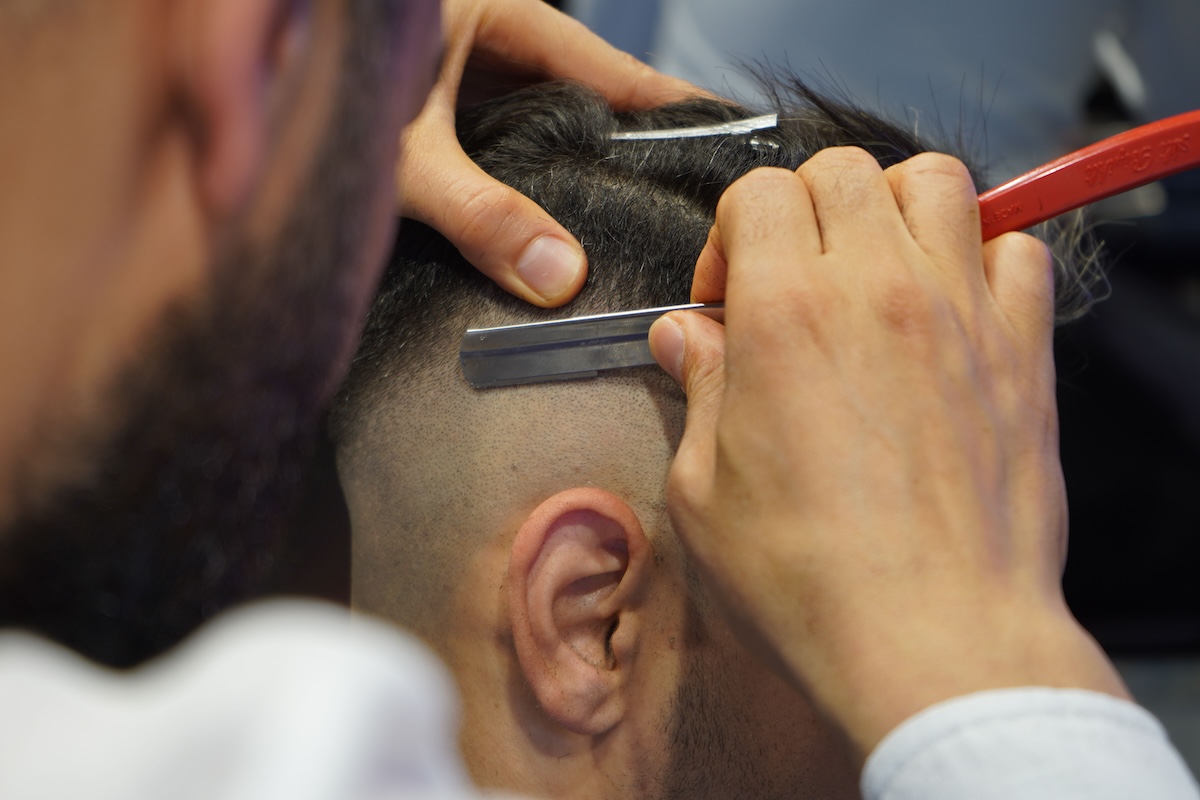
Start with the physical fact at the center of it. A haircut cannot be emailed. A straight-razor shave, a manicure, a pedicure, a beard trim: none of it can be shipped in a box, streamed to a device, or fulfilled from a warehouse in another state. It has to be delivered in person, in a specific place, by a trained pair of hands. There is no software update that changes that, and there is no marketplace that disintermediates it. A haircut is a haircut, a service you cannot get any way except by sitting in the chair.
That immunity looks more valuable the longer you sit with the numbers. E-commerce reached a record share of U.S. retail sales in early 2026, roughly 16.9 percent, and it took twenty-five years of relentless investment to get there. But that ceiling applies only to the sale of goods. The entire services economy, where haircuts and grooming live, sits outside the reach of e-commerce almost entirely. The businesses most consumer capital chased for two decades were vulnerable precisely because they could be delivered through a screen, which also made them endlessly contestable on price and exposed to the next platform. A service delivered only in the chair has none of that exposure.
Goods Retailers Are Closing While Service Businesses Move In
The clearest evidence that this distinction matters is in the commercial real estate market. The goods side of the economy has been absorbing steady damage: Coresight Research projected on the order of 15,000 U.S. store closures in 2025 against only about 5,800 openings, a roughly three-to-one ratio that has become the drumbeat of physical retail. What fills the space those closures leave behind is the instructive part. Landlords are increasingly re-leasing vacated big-box and soft-goods square footage to service and experience tenants (fitness, wellness, dining, grooming) precisely because those businesses cannot be purchased online and generate the repeat foot traffic a shopping center needs. The retailer that sold a product a customer can now buy on a phone is the vulnerable tenant. The business that provides a service a customer must show up for is the tenant landlords now compete to attract. In practice, that can mean priority access to strong locations and more favorable lease terms for a well-capitalized operator.
Services Spending Is Where the Money Went
Consider, too, where consumer dollars have migrated. Services now make up roughly two-thirds of all U.S. consumer spending, and the share has been climbing for years; in the most recent monthly data from the Bureau of Economic Analysis, services accounted for about sixty percent of the growth in consumption. Americans have been spending a rising share of their income not on things but on experiences and personal care, and men, specifically, are a fast-growing part of that story. Grooming that many men did not regularly pay for a generation ago has become routine: skincare, nail care, the standing appointment rather than the occasional cut.
That shift carries a second implication an investor thinking about a downturn should weigh carefully. Goods spending, and durable goods in particular, is the volatile, cyclical part of consumption: the new car, the furniture, the appliance that can be deferred a year when money is tight. Services spending has historically been far steadier through economic cycles, because so much of it is habitual and hard to postpone. A Hammer & Nails member visits every two to four weeks not as an indulgence he reconsiders each month but as part of how he maintains himself. Habitual, locally delivered services are structurally more stable demand than discretionary, shippable goods.
The Honest Case on Downturns
It is worth being precise about how this category behaves in a downturn, because the temptation in a capital raise is to reach for a word like "recession-proof," and no consumer business earns it. Discretionary spending softens when money is tight, and grooming is not a utility. What can be said, and defended, is narrower and more useful: this category has historically shown more resilient demand than most consumer businesses, for reasons that are structural rather than hopeful. Its demand cannot be exported to a cheaper online substitute, because there is no online substitute. Its cadence is habitual, which makes it stickier than a one-off purchase. And its customer base skews affluent and efficiency-minded, the kind of customer who tends to protect a modest monthly routine long after trimming larger discretionary line items. There is even a well-worn consumer-behavior argument, sometimes called the "lipstick effect," that small, affordable self-care purchases hold up comparatively well when people cut back on big ones; the evidence for it is debated, and we would not rest a case on it, but it points in the same direction as the sturdier structural facts. The claim here is not that demand is immune to a recession. It is that the resilience is structural rather than wished onto it.
Resilient and Growing at the Same Time
It would be a mistake to read all of this as a purely defensive case, a bunker to wait out bad weather in. The same category is also growing. The U.S. men’s grooming market was estimated at roughly $46.5 billion in 2023 and is projected to reach about $81 billion by 2030, a compound annual growth rate in the neighborhood of 8 percent, as men spend more on grooming, wellness, and services many of them simply did not use in the past. That is the unusual combination at the heart of the opportunity: a category resilient enough to hold up comparatively well through a downturn, and a market growing fast enough to reward building into it. Most businesses offer one or the other. This one offers both.
Durable Demand, Seen at a Glance
The clearest way to see what makes this demand durable is to set it beside the kind of business that dominated the last cycle, the shippable, downloadable, discretionary one, and read down the column.
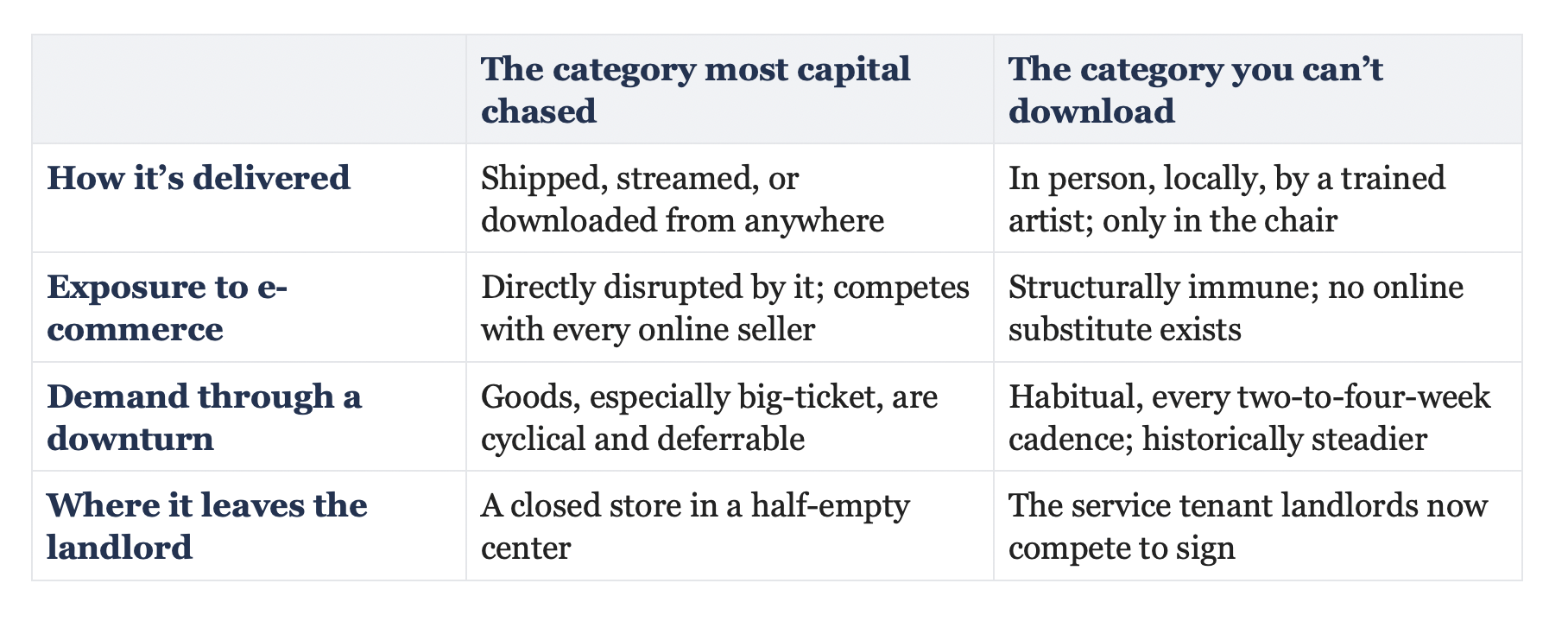
Read down the right-hand column and the through-line is simple: this demand is hard to disrupt because it must be delivered in person, and it is steadier through a cycle because it is habitual and local. That is the foundation. But durable demand is not the same thing as durable cash flow. Foot traffic only becomes predictable revenue when a business is built to capture it that way.
From Durable Demand to Durable Cash Flow
This is where the resilience story hands off. Durable demand is the raw material; the membership model is what converts it into recurring, predictable revenue, and that is what turns a resilient category into durable cash flow. The distinction matters whether you are weighing this as an investor or as someone who might own and operate a shop. For an owner, recurring membership dues are the difference between hoping the chairs fill this month and knowing a base of revenue is committed before the doors open. For an investor in the broader platform, that same recurring revenue is what compounds across locations and makes the business more valuable to a future buyer. Either way the engine is the same, and it is the subject of the companion article in this series, "Recurring by Design."
Here it is enough to see the backdrop against which the Hammer & Nails Texas platform is being built: a plan to grow from six operating shops today to twenty or thirty across Texas under one centralized platform, in a category that e-commerce cannot reach and that has historically held its demand more steadily than most. This piece is about the ground it all stands on: a service you cannot download, in a place a customer has to come to.
The Real Question
The last cycle rewarded the businesses that could be delivered through a screen. The question worth sitting with is whether the next one rewards the opposite: the service that has to be delivered in person, that people return for out of habit rather than novelty, and whose demand has tended to hold steadier through a downturn than the shippable, discretionary categories around it. No consumer business is recession-proof, and this article has been careful not to claim otherwise. But a category that cannot be downloaded, cannot be shipped, and comes with a growing market attached rather than a shrinking one is an unusual place to look for resilience. Whether that is the kind of foundation you want under an investment is the more interesting question, and it is worth a conversation.
To learn more, visit summitviewtexas.com.
This article is for informational purposes only. It is not legal, tax, or investment advice, and it is not an offer to sell or a solicitation of an offer to buy any security or franchise. Any offer is made only through the offering’s definitive documents to verified accredited investors, and those documents, not this article, govern in all respects. Third-party market, economic, and industry data are presented as reported and have not been independently verified; characterizations of demand resilience, stability, and category durability reflect management’s analysis of that data and are not guarantees of future performance. Store counts and development plans reflect the company’s current plans and are subject to change; an investor could lose some or all of an investment.
•••••
Sources
- U.S. Census Bureau / Federal Reserve Bank of St. Louis (FRED): E-Commerce Retail Sales as a Percent of Total Sales (e-commerce reached approximately 16.9% of U.S. retail sales in Q1 2026, its highest share on record, a ceiling that applies only to the sale of goods). https://fred.stlouisfed.org/series/ECOMPCTSA
- Coresight Research: 2025 U.S. Store Openings and Closures Forecast (projected roughly 15,000 U.S. store closures in 2025 against approximately 5,800 openings; vacated retail space increasingly re-leased to internet-resistant service tenants). https://www.businesswire.com/news/home/20250123760119/en/Coresight-Research-Predicts-2025-Store-Opening-Closure-Numbers
- U.S. Bureau of Economic Analysis: Personal Income and Outlays (services make up the majority, roughly two-thirds, of U.S. personal consumption expenditures, and accounted for the larger share of recent spending growth). https://www.bea.gov/data/consumer-spending/main
- Grand View Research: U.S. Men’s Grooming Products Market Report (U.S. men’s grooming market estimated at ~$46.5 billion in 2023, projected to reach ~$81 billion by 2030 at a CAGR of approximately 8%). https://www.grandviewresearch.com/industry-analysis/us-mens-grooming-products-market-report
Third-party market, economic, and industry data above are presented as reported and have not been independently verified. Statements describing the SummitView and Hammer & Nails Texas platform, including its current Texas footprint of six shops and the 20 to 30 location development plan, are drawn from the company’s investor and offering materials, including the Hammer & Nails Texas Holdings, LP investor presentation, and are subject to change. Characterizations of the category’s demand resilience and durability reflect management’s analysis of the cited data. Any observations not attributable to an outside source reflect management’s experience, views, and beliefs, and are not independent research, legal advice, or a guarantee of results.
Comprehensive Summary
Why is a service business like Hammer & Nails structurally different from the businesses e-commerce disrupted?
- The physical fact is absolute, not just currently true: a haircut, shave, manicure, or beard trim has to be delivered in person by a trained pair of hands, there's no software update or marketplace that changes that.
- The e-commerce ceiling only applies to goods: e-commerce reached a record 16.9 percent of U.S. retail sales in early 2026, but that milestone took 25 years and applies exclusively to the sale of goods, not services.
- What made the last cycle's winners vulnerable is exactly what this category lacks: businesses delivered through a screen were endlessly contestable on price and exposed to the next platform; a service delivered only in the chair carries none of that exposure.
- This isn't a temporary advantage waiting to be disrupted: the immunity is structural to what the service is, not a head start that a better app eventually closes.
Is there real evidence this immunity matters, or is it just a talking point?
- Commercial real estate is showing it directly: Coresight Research projects roughly 15,000 U.S. store closures in 2025 against only about 5,800 openings, a three-to-one ratio that's become the defining pattern of physical retail.
- What replaces those closures reveals what landlords actually want: vacated big-box and soft-goods space is increasingly re-leased to service and experience tenants, fitness, wellness, dining, grooming, specifically because those businesses can't be purchased online.
- The tenant hierarchy has effectively flipped: the retailer selling a product a customer can now buy on a phone is the vulnerable tenant, while the business requiring a customer to physically show up is the one landlords compete to attract.
- That shift has a practical payoff for a well-capitalized operator: priority access to strong locations and more favorable lease terms, real economic advantages, not just favorable positioning.
Where has consumer spending actually gone, and is it steady or cyclical?
- The migration is already substantial: services now make up roughly two-thirds of all U.S. consumer spending, and Bureau of Economic Analysis data shows services driving about 60 percent of recent consumption growth.
- Men specifically are a fast-growing part of that shift: grooming spending many men didn't regularly make a generation ago, skincare, nail care, a standing appointment rather than an occasional cut, has become routine.
- Goods and services behave differently through a cycle: durable goods spending is the volatile part of consumption, the new car or appliance that can be deferred a year, while services spending has historically been steadier because so much of it is habitual and hard to postpone.
- A membership visit is maintenance, not indulgence: a member returning every two to four weeks isn't reconsidering the purchase each month, which is a structurally different demand pattern than a discretionary, shippable good.
Is Hammer & Nails recession-proof?
- No, and the claim is deliberately not made: discretionary spending softens when money is tight, and grooming is not a utility, no consumer business earns the label "recession-proof."
- What's actually defensible is narrower and more useful: the category has historically shown more resilient demand than most consumer businesses, for structural reasons rather than hopeful ones.
- Three structural reasons support that resilience specifically: there's no online substitute to lose share to, the visit cadence is habitual rather than one-off, and the customer base skews affluent and tends to protect a modest monthly routine even while cutting bigger expenses.
- The "lipstick effect" is mentioned but not leaned on: the idea that small self-care purchases hold up when people cut back on big ones points in the same direction, but the evidence is debated and the case doesn't rest on it, the structural facts do the real work.
Is this just a defensive, wait-out-the-downturn category, or is it actually growing?
- It's genuinely both at once: a category resilient enough to hold up through a downturn, and a market growing fast enough to reward building into it right now.
- The growth numbers are specific: the U.S. men's grooming market was estimated at roughly $46.5 billion in 2023, projected to reach about $81 billion by 2030, an 8 percent compound annual growth rate.
- Most comparable categories force a choice between the two: a defensive category that isn't growing, or a growth category with no downside protection.
- This is the actual investment case, not just a hedge: resilience without growth is a bunker; growth without resilience is a bet on the cycle staying favorable. Having both is the unusual part worth underwriting.
How does this connect to the actual Hammer & Nails Texas platform?
- Durable demand and durable cash flow are two different things: this piece establishes the demand is structurally resilient; converting that demand into recurring, predictable revenue is the membership model's job, covered in the companion piece in this series.
- The distinction matters differently depending on who's asking: for an owner, committed membership dues mean knowing revenue exists before the doors open each month; for a platform investor, that same recurring revenue compounds across locations and drives what a future buyer will pay.
- This is explicitly the foundation, not the whole case: the platform's plan to grow from six operating shops today to 20 to 30 across Texas is built on top of this demand durability, not instead of it.
- The core distinction in one sentence: a service you cannot download, delivered in a place a customer has to physically come to, is a different kind of asset than anything that competed for attention on a screen.