

Recurring by Design: The Membership Model Behind Hammer & Nails Texas

Article Summary
Recurring revenue. A business customers like still has to win every dollar from scratch each visit. Hammer & Nails converts episodic haircuts into monthly membership dues across three tiers, so the business knows a base of revenue is coming in before the doors open on the first of the month, that predictability is what an investor pays for.
Members pay monthly dues for a defined set of services within each 30-day period, across three tiers: Classic Club, VIP Club, and Club Luxe. Benefits layer on top, rollover of unused services, sharing credits with family, complimentary upgrades, and retail discounts, but the mechanical effect is the same: unpredictable visits become predictable monthly revenue.
Because the stickiness comes from relationships, not penalties. A member typically knows four people in the shop, the general manager, the concierge, the cut-and-shave artist, and the hand-and-foot artist, each of whom knows his preferences and his standing appointment. Leaving means unwinding four relationships and starting over elsewhere, not just canceling a subscription.
Because it produces earnings visibility a transactional business can't offer. Companies in Zuora's Subscription Economy Index have grown revenue meaningfully faster than the broader S&P 500 in recent years, reflecting how durable and compounding recurring-revenue streams tend to be. It also raises each member's lifetime value and smooths out the seasonality that makes an ordinary service business hard to forecast.
By handing an institutional buyer earnings visibility a project-based business can't. The platform's strategy is to grow from six shops today to 20 to 30 across Texas, compounding predictable membership revenue across a denser cluster of locations, and position for a strategic sale in roughly five to seven years. Management's target exit multiple rests directly on that recurring-revenue quality.
A business customers return to is a good business. A business that turns those returns into predictable monthly revenue is an investable one. This is how the membership model does it, and why recurring revenue is the quality a buyer pays a premium for. It is the second of two forces behind the platform. A companion article covers the first: the resilient, e-commerce-proof demand underneath it.
There is a meaningful difference between a business that people like and a business with recurring revenue. Plenty of good local businesses earn genuine loyalty and still have to win every dollar from scratch. The customer comes back when he happens to need something, and the owner finds out how the month went only when it is over. Recurring revenue is the quality that changes that, and it is the quality that turns a good category into an investable one. A companion article in this series makes the case that men’s grooming is unusually durable demand: a service e-commerce cannot touch, bought on a habitual cadence. This article is about the machine that sits on top of that demand and converts it into revenue you can see coming: the membership model.
How the Membership Model Works
Hammer & Nails is a membership-based brand rather than a walk-in shop that hopes you return. Members pay dues every month and, in return, receive a defined set of services they can use within each 30-day period. The tiers are built to match how a given man actually grooms: a Classic Club for two classic services a month, a VIP Club for three signature services, and a Club Luxe tier for four luxury services. Member benefits layer on top, from rollover of unused services to sharing credits with family and friends, complimentary upgrades, and meaningful discounts on retail and add-ons. The mechanical effect is the important part: a stream of episodic, hard-to-predict visits is converted into monthly recurring revenue, an amount the business can count on before the doors open on the first of the month.
Why Recurring Revenue Is Prized
Investors pay more for a dollar that arrives predictably every month than for a dollar that has to be re-won each time, and they do so for a concrete reason: recurring revenue produces earnings visibility a transactional business can never offer. It is why the market has rewarded subscription models across industries. Companies in Zuora’s Subscription Economy Index have grown revenue meaningfully faster than the broader S&P 500 in recent years, a reflection of how durable and compounding recurring-revenue streams tend to be. Frank Muller, who built the SummitView platform and is among the largest franchisees in the Hammer & Nails system, describes the operator’s version of the same idea in plain terms: a mature shop is one where you "wake up each month" already knowing a large base of dues is coming in. Predictable monthly revenue also raises the lifetime value of each member and smooths the seasonality and single-transaction risk that make an ordinary service business hard to forecast.
Sticky Without a Contract
The obvious worry with any membership is churn: if members can leave, how recurring is the revenue really? The Hammer & Nails answer is deliberately counterintuitive. There is no contract and no commitment, and a member can cancel anytime. The stickiness is engineered from relationships rather than penalties. In Muller’s telling, a member comes to know four different people in the shop: the general manager, the membership concierge, the cut-and-shave artist, and the hand-and-foot artist, each of whom knows his preferences, his standing appointment, and his drink. Leaving is not canceling a subscription; it is unwinding four relationships and going back to hunting for a barber who does none of the rest. Add a booked-in-advance standing appointment and, in a mature shop, a waitlist for the spot a member would give up, and the result is real retention without a single day of contractual lock-in. That is why the recurring revenue the model produces is more durable than the "cancel anytime" language would suggest.
From Recurring Revenue to Exit Value
Recurring revenue is not only pleasant to operate on; it is the specific quality that makes a services platform attractive to an institutional buyer at exit, because it hands that buyer earnings visibility a project-based business cannot. This is the logic the Hammer & Nails Texas platform is built around. The strategy is to grow from six operating shops today to twenty or thirty across Texas under one centralized platform, compounding predictable membership revenue across a dense cluster of locations, and to position the company for a strategic sale in roughly five to seven years. Clustering matters here: density improves brand awareness, shares marketing and management efficiency across shops, and reduces the risk of any single location. The recurring revenue does not just add up; it compounds on a sturdier base. Management’s stated target, an exit at a high EBITDA multiple, rest directly on that recurring-revenue quality: durable monthly cash flow, multiplied across a region, sold to a buyer who will pay a premium for its predictability. These are goals and current projections, not promises, and the specifics live in the offering documents rather than in an article.
Two Kinds of Revenue
The clearest way to see the difference is to set recurring membership revenue beside the one-off, transactional revenue most service businesses actually run on, and read down the column.
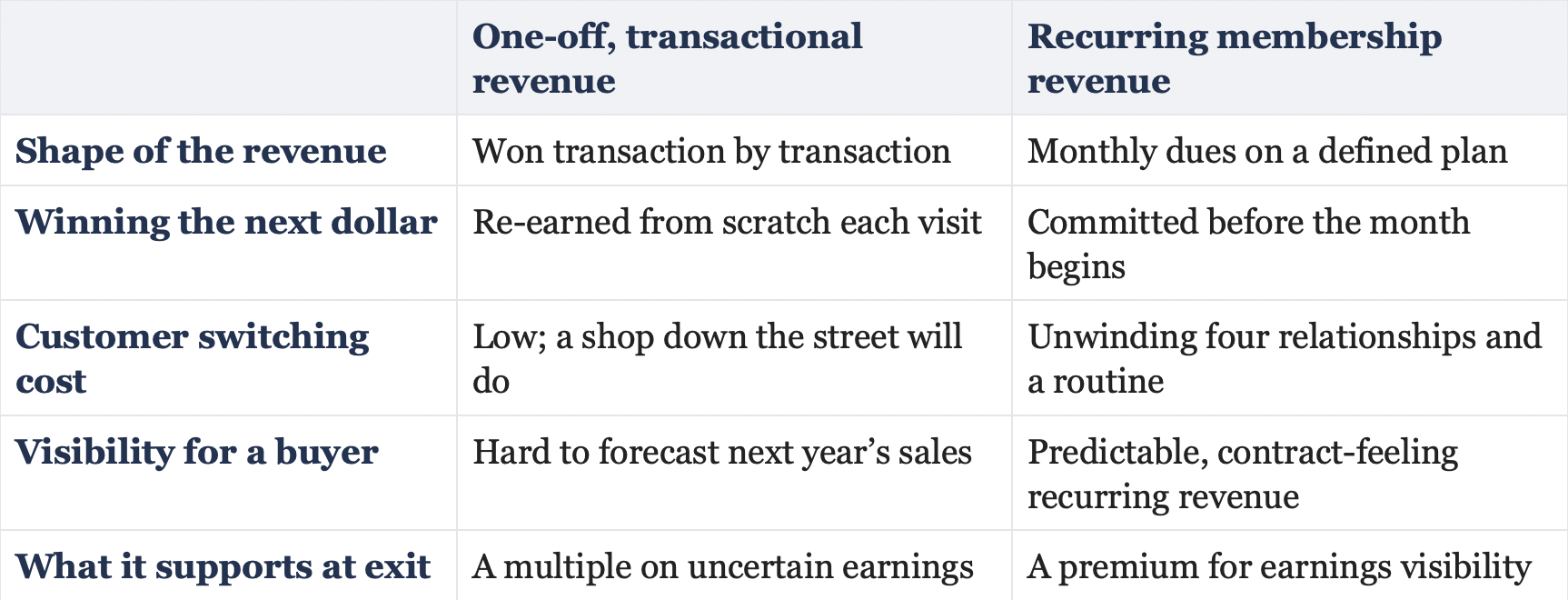
Read down the right-hand column and the appeal is plain. The same haircut, sold as a walk-in, is a dollar the business has to chase again next month; sold inside a membership, it is a dollar the business can plan around and a buyer can underwrite. The service does not change. The revenue does.
The Force That Makes It Durable
A membership model is only as durable as the demand underneath it. Recurring revenue built on a service that could be disrupted, disintermediated, or easily dropped is far less valuable than it looks. That is exactly why the two forces belong together. The demand under this membership model is unusually hard to erode: it is a service e-commerce cannot deliver, bought on a habitual cadence, in a category that has historically held up comparatively well through downturns. That resilience is the subject of the companion article, "Resilient and Local." Taken together, the two describe why the cash flow here is worth structuring around: durable demand that resists disruption, wrapped in a membership that turns it into recurring, predictable revenue.
The Real Question
A membership is easy to describe and hard to build. It asks a business to earn a monthly relationship rather than a single sale, and to keep earning it without a contract to fall back on. When it works, it changes what the business is worth: episodic visits become recurring revenue, recurring revenue becomes earnings visibility, and earnings visibility is what a buyer pays a premium for at exit. The interesting question for an investor is not whether people will keep getting haircuts. They will. The question is whether a platform can capture that habit as predictable, compounding, membership revenue across a growing footprint. That is the whole design here, and it is worth a conversation.
To learn more, visit summitviewtexas.com.
This article is for informational purposes only. It is not legal, tax, or investment advice, and it is not an offer to sell or a solicitation of an offer to buy any security or franchise. Any offer is made only through the offering’s definitive documents to verified accredited investors, and those documents, not this article, govern in all respects. Descriptions of the membership model, pricing tiers, and member benefits reflect the company’s current program and vary by market. Offering size, store counts, development plans, and target returns reflect the company’s current plans and projections and are subject to change; target returns are goals, not guarantees, and an investor could lose some or all of an investment.
•••••
Sources
- Zuora: 2025 Subscription Economy Index (companies with recurring-revenue models have grown revenue meaningfully faster than the broader S&P 500 in recent years, reflecting the durability and compounding of subscription revenue). https://www.zuora.com/press-release/zuora-subscription-economy-index-2025/
- Grand View Research: U.S. Men’s Grooming Products Market Report (U.S. men’s grooming market estimated at ~$46.5 billion in 2023, projected to reach ~$81 billion by 2030 at a CAGR of approximately 8%, supporting the runway over which membership revenue can compound). https://www.grandviewresearch.com/industry-analysis/us-mens-grooming-products-market-report
Third-party market and industry data above are presented as reported and have not been independently verified. Statements describing the SummitView and H&N Texas platform, including its membership-based model, pricing tiers and member benefits, its current Texas footprint of six shops, the 20 to 30 location development plan, the market-density strategy, the up-to-$15 million raise in H&N Texas Holdings, LP, open to accredited investors, and the target net IRR, exit multiple, and five-to-seven-year platform sale, are drawn from the company’s investor and offering materials, including the H&N Texas Holdings, LP investor presentation, and are subject to change. Remarks attributed to Frank Muller reflect his recorded management commentary. Any observations not attributable to an outside source reflect management’s experience, views, and beliefs, and are not independent research, legal advice, or a guarantee of results.
Comprehensive Summary
What actually makes Hammer & Nails an "investable" business rather than just a good one?
- Being liked and being recurring are different qualities entirely: plenty of good local businesses earn genuine loyalty and still have to win every dollar from scratch each time a customer happens to need something.
- The membership model closes that gap: it converts a stream of episodic, hard-to-predict visits into monthly recurring revenue the business can count on before the doors open.
- This is the quality that turns a good category into an investable one: a companion piece establishes that men's grooming demand is unusually durable; this piece is about the mechanism that captures that demand as revenue.
The distinction matters most at the point of underwriting: an investor isn't betting on whether people will keep getting haircuts, they will, the bet is on whether a platform can capture that habit as predictable, compounding revenue.
How does the membership model actually work?
- Members pay dues for a defined set of services, not a la carte visits: each 30-day period comes with a set number of services across three tiers, Classic Club, VIP Club, and Club Luxe, matched to how a given man actually grooms.
- Member benefits reinforce retention on top of the core structure: rollover of unused services, sharing credits with family and friends, complimentary upgrades, and discounts on retail and add-ons.
- The mechanical effect is the entire point: episodic, hard-to-predict visits become monthly recurring revenue, an amount the business can plan around rather than discover after the fact.
- This is a structural choice, not an add-on feature: Hammer & Nails is built as a membership-based brand from the ground up, not a walk-in shop that added a loyalty program later.
If there's no contract, why doesn't this revenue just churn away?
- The stickiness is deliberately engineered from relationships, not penalties: there's no commitment and a member can cancel anytime, the retention comes from somewhere else entirely.
- A member typically knows four people in the shop: the general manager, the membership concierge, the cut-and-shave artist, and the hand-and-foot artist, each of whom knows his preferences and his standing appointment.
- Leaving is a bigger decision than canceling a subscription: it means unwinding four relationships and going back to hunting for a barber who does none of the rest.
- Booked-in-advance appointments and waitlists compound the effect: in a mature shop, a member giving up his standing appointment is giving up a spot someone else is waiting for, adding real friction to leaving without a single day of contractual lock-in.
Why do investors specifically pay more for recurring revenue?
- It produces earnings visibility a transactional business can't offer: a dollar that arrives predictably every month is worth more than a dollar that has to be re-won each time.
- The broader market already prices this: companies in Zuora's Subscription Economy Index have grown revenue meaningfully faster than the broader S&P 500 in recent years, reflecting how durable and compounding recurring-revenue streams tend to be.
- Predictable revenue raises lifetime value per member: and smooths out the seasonality and single-transaction risk that make an ordinary service business difficult to forecast.
- This isn't unique to grooming: it's the same quality the market has rewarded across subscription businesses generally, applied here to a service category with unusually durable underlying demand.
How does recurring revenue actually translate into exit value?
- Recurring revenue is what makes a services platform attractive to an institutional buyer: it hands that buyer earnings visibility a project-based business can't provide.
- The strategy is built to compound that advantage: growing from six operating shops today to 20 to 30 across Texas under one centralized platform, concentrating predictable membership revenue across a denser cluster of locations.
- Clustering isn't incidental to this: density improves brand awareness, shares marketing and management efficiency across shops, and reduces the risk carried by any single location.
- The target exit rests directly on this quality: durable monthly cash flow, multiplied across a region, sold to a buyer who pays a premium specifically for its predictability, these are current goals and projections, not guarantees, with specifics governed by the offering documents.
How does this connect to the resilient-demand argument in the companion article?
- A membership model is only as durable as the demand underneath it: recurring revenue built on a service that could be disrupted or easily dropped is far less valuable than it looks on paper.
- The companion piece establishes exactly that durability: the demand is a service e-commerce cannot deliver, bought on a habitual cadence, in a category that has historically held up comparatively well through downturns.
- The two pieces describe two different halves of the same asset: durable demand is the raw material, the membership model is what converts that raw material into recurring, predictable revenue.
- Together they make the actual investment case: demand that resists disruption, wrapped in a structure that turns it into earnings visibility, is what a buyer is actually paying for at exit, not just a popular grooming brand.